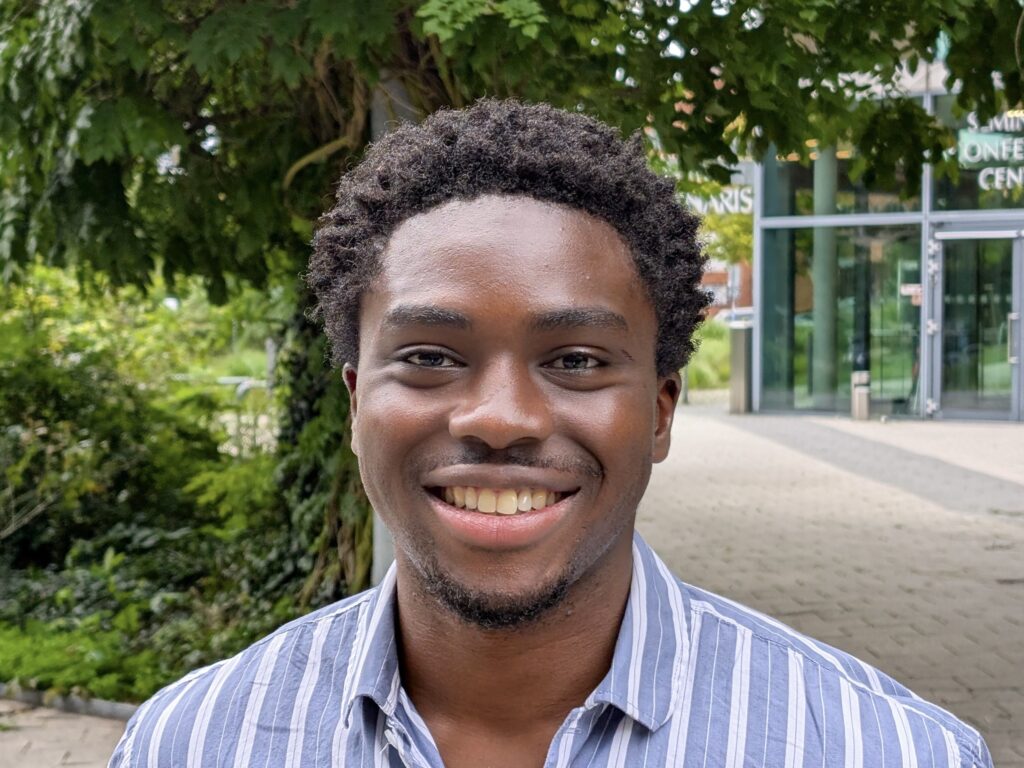
„The future is based on an understanding of the past. As long as we do not confront Germany’s colonial history, colonial structures will persist. Through these tours, I hope to help raise awareness of the lasting effects of colonialism on our society and encourage critical thinking.“
– Britney is currently pursuing a master's degree in sociology

„Colonialism is not a thing of the past; rather, it continues to have an impact today in the form of social inequality and racism. The tours bring history to life and provide a safe space where people can engage in open dialogue.“—
Marissa is currently studying social work.

„By teaching about colonialism, we come to understand not only a country’s history, but also how global power structures came into being and why the world is the way it is today.“ —Abdoul is currently studying journalism, as well as social and cultural anthropology, in Berlin.
„I want to normalize a critical approach to colonialism, and I know that many people have difficulties with this. But I am also pleasantly surprised that there are many white people, including many white Germans, who are willing to adopt this critical perspective,“ Mvemba told DW.
Stake, teepee and totem: we stand near African Street and look at pictures of a playground that transforms the cultures of indigenous people in North America into a stereotyped playground for children. »Who is responsible?« asks a participant on the city tour. Justice Lufuma Mvemba, founder of »deSta - Decolonial City Tour«, answers simply: »The majority society«.
A memorial plaque at Wilhelmstraße 92 in Berlin-Mitte has commemorated the Berlin-Africa or Congo Conference of 1884 since 2005. It is used by many people as a sightseeing spot on important city tours - including DeSta (Decolonial City Tour). „On Sunday, January 25, I did another city tour and the memorial plaque was there. On the following Thursday, January 29, it had disappeared,“ says Justice Mvemba, founder of DeSta, in an interview with the Berliner Zeitung.
Continuities of German colonial crimes are still visible in Berlin today. Justice Mvemba wants to contribute to more education and enlightenment about this chapter of German history with the Decolonial City Tours - for example in the African Quarter, on topics such as black feminism or looted art in the Berlin Palace. Photo: Decolonial city tour/
The German Colonial Women's Association was founded at Potsdamer Straße 134 in 1907.
Chocolate is deeply rooted in colonialism, slavery and exploitation. European powers established cocoa plantations in colonies, used forced labor and enslaved millions of people to satisfy demand. Even today, colonial stereotypes in advertising and precarious working conditions in cocoa cultivation in the Global South reflect this unequal power structure.
The bust of Nefertiti, which has been in Berlin since 1913, has been the subject of long-standing demands for its return by Egypt. While Egypt considers the export to be illegal and demands its unconditional return, the Prussian Cultural Heritage Foundation argues that the 1912 division of the find is legal. The bust remains a major attraction in the Neues Museum.