
Since our founding in 2022, the Desta Food Tour has grown considerably. From the very beginning, our goal has been to address critical issues such as anti-racism, decolonization and the historical and contemporary connections between Africa and Germany. Over the past three years, we have steadily expanded our decolonial city tours in Berlin to different districts. In 2024, we proudly opened our Black Queer Feminism Tour a unique experience that explores how we need to unlearn colonial ways of thinking in many areas of our society and in the cultural spaces of the city.
Colonialism has had a fundamental impact on global nutrition, far beyond individual regions. Even the exchange of plants between Africa, Asia, Europe and America changed food cultures worldwide: corn, tomatoes, potatoes and chili originated in the New World, while sugar cane, coffee, tea and spices came to Europe from Africa and Asia.
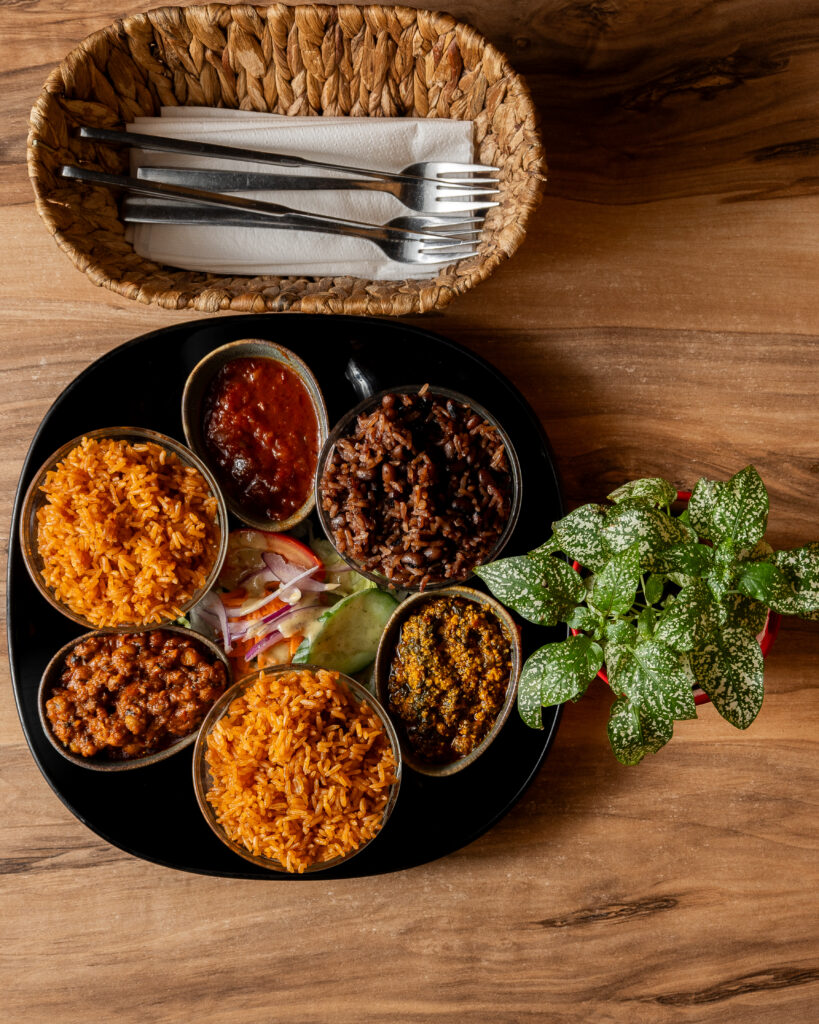
Without these movements, many of today's cuisines would look different; the idea that Italian pizza contains tomatoes or that Indian curries use chili peppers would be historically unthinkable. However, this exchange was not just a „friendly exchange“, but was often structurally unequal and mediated by power and violence: Colonial powers dictated which crops should grow food and which markets they had to serve, destabilizing local food systems.
In addition, the global spice trade shaped agricultural production in the occupied territories and established hierarchies of „valuable“ and „inferior“ that still influence cultural perceptions of food today.
Research on global food history also shows that colonial commodity flows were not just technical exchanges, but carried political and cultural meanings: they changed consumption patterns, enforced European eating norms and marginalized indigenous food systems.
Traces of colonial food and global eating habits can also be found in Berlin, both historically and in today's city life. In the late 19th century, Berlin was not only politically part of the German colonial project, but also a place where colonial goods, ideas and cultures converged.
The coffee we drink every day, the tea in our teacups or exotic spices in supermarkets are not neutral products: their global retail chains also linked Berlin with colonial flows of goods early on. At the same time, post-colonial migration and cultural diversity show how people from former colonies brought food cultures to Berlin. Indian curries, African dishes, Caribbean flavors and East Asian products are part of the Berlin menu today, a living example of how colonial history and global interdependencies are „tasted“ in everyday life.
At the same time, Berlin is a center of many initiatives that critically reflect on colonial structures and deconstructively illuminate them, e.g. through exhibitions, educational projects and city tours that make colonial foodways visible.
Perhaps you are wondering: What does food actually have to do with colonialism? And how does this fit in with Desta's mission, which aims to unlearn worldviews shaped by white supremacy, Western dominance and global power structures? These are precisely the questions this article explores: What is the connection between food and colonial power?
Food is more than just food; it is always also culture, identity and often an expression of social power relations. In colonial contexts, food was instrumentalized both as a means of control and as a symbol of cultural superiority: European colonizers often defined which foods were „civilized“ or „valuable“, marginalizing indigenous food practices.
At the same time, the contact between different cultures to new culinary mixturesVietnamese bánh mì, for example, was created from the interplay of French baguettes and local ingredients, and Jamaican patties reflect African, British and Caribbean influences. These hybrid cuisines are evidence of how people have creatively used colonial circumstances to create new food cultures, even under conditions of massive inequality and coercion.
Research into these cultural dimensions shows that colonial food not only functioned through cultivation and trade, but is deeply interwoven with taste, identity and social norms. It also makes it clear that food is a political terrain on which power relations were and are negotiated: Who decides which ingredients are valuable? Which dishes are considered „fine“ and which are considered „provincial“?
When talking about colonialism in conventional historiography, the focus is often on the social, political and economic consequences, especially those following the colonization of America. But food also played a major role in colonial history. The way people grow, prepare and consume food has been fundamentally reshaped over the last 500 years, especially for Indigenous communities and colonized populations.
Let's start with the colonization of the Americas. During this time, food was used by European powers as a mechanism for control and oppression. An early example comes from the Spanish Reconquista, where pork served as a cultural and religious symbol of Christian identity. Anyone who refused to eat pork was considered suspicious of being Jewish or Muslim, faiths that forbade its consumption. This instrumentalization of food continued during the colonization of America.
European settlers created hierarchies of „right“ and „wrong“ food based on European norms. Foods such as bread, olives and wine were considered appropriate and healthy, suitable for European bodies. In contrast, indigenous foods were often dismissed as inferior, unclean or dangerous. This devaluation of local food cultures was not merely symbolic, but part of a broader strategy to dominate and eradicate indigenous ways of life.
Colonialism has left not only cultural, but also social and economic traces in food systems. In many former colonies, local agricultural systems were forcibly transformed: Fertile soils were used for the cultivation of Cash Crops such as sugar cane, coffee or tea, which primarily served the export markets. This often meant the displacement of land used to grow traditional foods, undermining the food sovereignty of the local population.
This dynamic continues in many countries to this day, as structural dependencies on global markets, price fluctuations and imports persist. In addition, colonial trade relations influenced which products flowed into the metropolises and which remained locally, leading to social inequality in nutrition: domestic production was marginalized, while export-oriented agriculture was favoured.
Such structures often continue to have an impact for generations and explain why some regions are now more affected by imports, hunger crises or unhealthy dietary patterns, even though they were once rich in agricultural diversity.
These early examples mark the beginning of the intertwining of food systems and colonial power. As colonialism spread, food increasingly became a site of control. Europeans introduced new crops that radically changed the agricultural systems of colonized territories. Nowhere did this have a greater impact than on the African continent.
An impressive case study is the British colonial rule in Kenya. The British used military force, economic restructuring and cultural oppression to dominate the Kenyan population. One particularly damaging method was their treatment of land and agriculture. Fertile land was confiscated, traditional crops destroyed and indigenous food systems massively weakened.

As soon as European settlers arrived, they took over this land to grow cash crops such as tea and coffee: Products that served European economic interests. The traditional food systems of the indigenous Kenyan women were not only disrupted but systematically destroyed. New foods such as maize were introduced to provide a cheap labor force, not as a cultural choice but as a coercive colonial measure.
To this day, maize flour is a staple food in many African countries and a direct legacy of colonial policies. This example shows how colonialism reshaped African food systems in two ways: by eradicating traditional cultures and by introducing new foods that served the interests of the colonizers.
The question of how „German“ a dish like currywurst with chips really is leads us directly into the interconnectedness of global food history. At first glance, the currywurst may seem simple: a piece of meat and chips, but a closer look reveals a complex history. The main ingredients, tomato and potato, both originate from South America and only became known after European colonization.
Tomatoes spread via trade networks of the Columbian Exchange after European explorers brought plants back from the New World, and later became a central component of Mediterranean cuisine.
Potatoes, on the other hand, were also brought to Europe from the Andes and became a staple food there, although they were originally only found in South America. Curry spices, on the other hand, originally came from India and other parts of South Asia, becoming popular through colonial trade routes and finding their way into various European cuisines.
The meat and the bread roll may seem local, but the essential combination of spices and plant-based ingredients is inconceivable without colonial and global exchange processes. In the food tour that we offer, we illustrate these interdependencies: The currywurst thus becomes an entry point to show how global history lives on in a supposedly „typical German“ dish and how colonial structures still shape our plates today.
If you are fascinated by these powerful connections between colonialism and food, we invite you to join us on one of our decolonial Food tours in Berlin where taste, history and identity come together to tell an important, often suppressed story. We look forward to seeing you!
https://academic.oup.com/jsh/article/58/4/573/7729198
https://toxigon.com/the-impact-of-colonialism-on-food-culture
https://www.bpb.de/themen/kolonialismus-imperialismus/postkolonialismus-und-globalgeschichte/
https://en.wikipedia.org/wiki/Fusion_cuisine