
One of Berlin's most iconic exhibits is the striking bust of Queen Nefertiti, on display in the Neues Museum on Museum Island. She is regarded as a global symbol of beauty, power and the arts and crafts of ancient Egypt. Today, it is a central part of the debate about colonial looted art and the repatriation of cultural assets.
Its estimated value? A breathtaking 400 million euros.
But behind this celebrated artifact lies a long controversy. In 1912, a team of German archaeologists discovered the bust. Like many colonial-era objects, were they quickly brought to Berlin, where they are still on display today?
Nefertiti is one of the most famous women in ancient history. She lived in the 14th century BC during the 18th dynasty of ancient Egypt and was the main wife of the pharaoh Akhenaten. Her name means „the beautiful one has come“, which already indicates the importance of her appearance and her depiction in Egyptian art. However, Nefertiti was much more than just a royal wife. Historical reliefs and depictions often show her in unusually powerful positions, for example making offerings to the gods or even slaying enemies, a scene that was normally reserved for pharaohs.
During her husband's reign, Nefertiti played a central role in one of the most radical religious reforms in Egyptian history. Akhenaten introduced a new religious order in which the sun god Aten was worshipped as the most important deity. This religious revolution broke with the traditional Egyptian polytheism and led to the foundation of a new capital: Amarna. During this period, Nefertiti was often depicted alongside her husband, suggesting that she may have acted as co-regent or at least as a highly influential political figure.
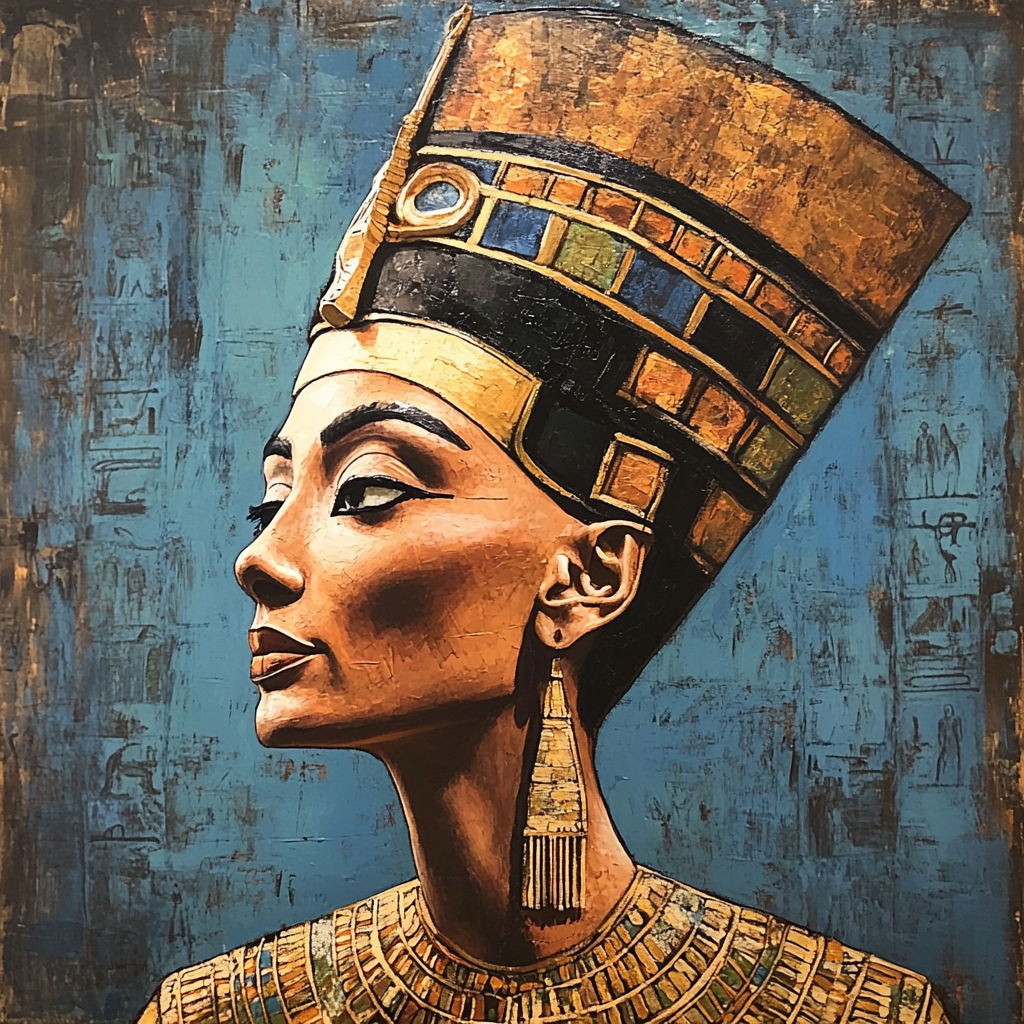
Their era also marked an important artistic change. The so-called Amarna art depicted people more realistically than earlier Egyptian art styles. Figures were depicted with softer facial features and more individual characteristics. The famous bust of Nefertiti is an outstanding example of this new artistic direction. To this day, it is considered one of the most important portraits from antiquity and a symbol of the beauty and cultural prosperity of ancient Egypt.
The famous bust of Nefertiti was December 6, 1912 discovered during archaeological excavations in the ancient city of Amarna. The excavations were carried out by a German team led by Egyptologist Ludwig Borchardt. The expedition was financed by the German Orient Society and the Berlin patron of the arts James Simon.
The spectacular discovery was made in the remains of a workshop complex attributed to the royal sculptor Thutmose. In this workshop, archaeologists discovered numerous models, plaster molds and sculpture fragments, which presumably served as models for official representations of the royal family. Among these objects was the now world-famous bust of Nefertiti. It is made of limestone covered with painted plaster and measures around 48 centimetres in height. The exceptionally good state of preservation of the sculpture is particularly remarkable.
Borchardt himself enthusiastically described the moment of discovery in his diary. He noted that the sculpture seemed so alive that words could hardly describe it. This emotional reaction shows the impression the bust made on its first viewers. Shortly after its discovery, it became part of the division of finds between Egypt and Germany, a common practice in archaeological excavations at the time.
The discovery of the bust of Nefertiti took place at a time when archaeological research was strongly influenced by European colonial powers. In the early 20th century, European states controlled many regions of the Middle East and North Africa politically or economically. Egypt itself was under strong British influence at this time. These power relations had a direct influence on archaeological research and the handling of ancient artifacts.
Many archaeological projects were financed and managed by European institutions. Scientists from Germany, Great Britain or France received excavation licenses from the local authorities. In return, a system of sharing finds, known as „partage“, was often used. The objects discovered were divided between the excavation team and the country of origin. This practice was considered legal and common at the time, but is now viewed critically.
Critics argue that this system was strongly influenced by colonial power structures. European researchers had financial resources, scientific networks and political influence at their disposal, while local authorities often had less room for maneuver. As a result, numerous important artifacts from the Middle East and Africa ended up in European museums
After the bust of Nefertiti was brought to Germany in 1913, it initially ended up in the private collection of the Berlin patron James Simon. A few years later, he donated the bust to the Berlin museums, where it became part of the state collection.
The bust was first exhibited publicly in 1924 and immediately attracted international attention. Visitors from all over the world traveled to Berlin to see the exceptionally well-preserved portrait of the Egyptian queen. The sculpture quickly became one of the most famous works of art of the 20th century.
During the Second World War, the bust had to be moved several times for security reasons. Like many valuable works of art, it was hidden away to protect it from bombing raids. In the meantime, it was even stored in a salt mine, where numerous German museums kept their most valuable objects. After the war, the bust initially ended up in various museums in West Berlin.
Since 2009, the sculpture has been housed in the Neues Museum on Museum Island, which was reopened after extensive restoration work. There it forms the central exhibit of the Egyptian collection and attracts hundreds of thousands of visitors every year.
The former Egyptian Minister of Antiquities, Zahi Hawass, reignited the debate in September 2024 by launching a petition demanding the return of the bust. He argues that the artifact was illegally taken out of the country and must be returned to its rightful place.
The Prussian Cultural Heritage Foundation, responsible for the Berlin museum collections, however, insists that the bust was acquired legally. But is this claim really tenable?
In the early 1910s, Egypt was under British colonial rule and had few resources for its own excavations. German archaeologists, financed by the businessman James Simon, were therefore given permission to excavate artifacts. The agreement at the time provided for a 50:50 split of the approximately 10,000 finds. This was common practice before the rules changed fundamentally in 1922 after the excavation of Tutankhamun's tomb.
Germany claims that an Egyptian representative fairly selected half of the finds, including the bust of Nefertiti. Cairo, on the other hand, argues that Ludwig Borchardt deliberately concealed the bust's significance in order to smuggle it out of Egypt. The bust initially remained in Simon's private collection for a decade before going on public display in Berlin in 1924.
The discussion about the return of the bust of Nefertiti is part of a larger global debate about the repatriation of cultural assets. Many artifacts on display in European museums today originally came from former colonies or from regions that were politically influenced by European powers in the 19th and early 20th centuries.
A well-known example is the Benin Bronzes. These works of art were stolen by British troops in 1897 during a military expedition from the Kingdom of Benin in present-day Nigeria. Many of these objects are now in European and American museums. In recent years, several countries have begun to return parts of these collections to Nigeria.
Another famous object is the Rosetta Stone, which is in the British Museum. The stone was crucial for deciphering Egyptian hieroglyphics, but was taken to Great Britain during the Napoleonic Wars. Here, too, Egypt has been demanding its return for years.

These examples show that the debate about cultural heritage goes far beyond the case of Nefertiti. Museums around the world are under increasing pressure to critically examine their collections and develop new forms of international cooperation.
Restitution has been refused for over a hundred years, a pattern that is evident in Europe in the face of many demands for the repatriation of colonial cultural assets.
The German government refers to the fragility of the bust, possible precedents and the lack of a legal basis. The official position of the foundation continues to read:
„There are currently no negotiations with Egypt on the return of the statue.“
In recent decades, international organizations have attempted to better regulate the protection of cultural property. One of the most important agreements is the UNESCO Convention of 1970. This agreement obliges the signatory states to prevent the illegal trade in cultural property and to return stolen artifacts to their countries of origin.
The convention was created in response to the increasing international trade in antique objects. Many archaeological artifacts were illegally excavated in the course of the 20th century and then sold on the art market. The aim is to prevent such practices through international cooperation.
An important problem, however, is that many famous objects were taken abroad long before these laws were introduced. The bust of Nefertiti, for example, was brought to Germany as early as 1913. As a result, today's international regulations often do not have legal recourse to such historical cases.
Nevertheless, these laws are influencing today's debate on restitution. Many states argue that older cases should also be reassessed in the interests of historical justice. Museums, on the other hand, often emphasize that they play important roles in the protection and research of such objects.
Some argue that the bust acts as a „cultural ambassador“ for Egypt. However, Egyptian archaeologist Monica Hanna clearly disagrees:
„If an ambassador is only sent in one direction, she is a hostage.“
Today, the bust of Nefertiti is not only an archaeological artifact, but also an important cultural and economic symbol. Since its first public exhibition in 1924, it has become one of the most famous sculptures in the world. Millions of people know the face of the Egyptian queen from books, documentaries or museum visits.
The bust has a special significance for Berlin. It is considered the central exhibit of the Neues Museum on Museum Island. Hundreds of thousands of tourists visit the museum every year and many of them come specifically to see the famous sculpture. As a result, the bust indirectly contributes to the economic importance of cultural tourism in the city.
In addition, the image of Nefertiti is reproduced worldwide. It appears in textbooks, exhibitions, films and souvenirs. Replicas of the bust are sold in various sizes and are a popular collector's item. As a result, the sculpture has become a global symbol of ancient Egypt.
This cultural and economic significance also plays a role in the debate about its possible restitution. While some argue that it is a central part of Egypt's cultural heritage, others see it as part of a global museum network that makes art and history accessible to an international audience.
In addition to ticket sales, the bust generates considerable income. Replicas are sold in the museum store for 48 euros. A Berlin newspaper even used her image to advertise Berlin as a „migration-friendly city“.
Should Berlin return the bust of Nefertiti to Egypt to acknowledge its colonial past? Or should the city continue to hold on to the artifact?
Discuss this question with us in the tour Humboldt Forum.
https://www.britannica.com/biography/Nefertiti
https://www.britannica.com/science/archaeology
https://en.wikipedia.org/wiki/Nefertiti_Bust
https://www.smb.museum/en/museums-institutions/neues-museum/
https://www.britishmuseum.org/collection/object/Y_EA24
https://www.britannica.com/topic/Benin-bronzes
https://www.unesco.org/en/fight-illicit-trafficking
https://www.britannica.com/topic/UNESCO
https://www.dw.com/de/nofretete-restitution-%C3%A4gypten-petition-berlin/a-74636617