
Celia Cruz, known as the queen of salsa, She always spoke about resistance and freedom and connected deeply with the decolonial struggles of diverse population groups. Her music, vibrant personality and powerful message made her an iconic figure whose influence transcends borders and resonates worldwide.
Celia Caridad Cruz Alfonso was born on October 21, 1925 in the Santos Suárez neighborhood of Havana, Cuba, into a large family under modest circumstances. As one of fourteen children, she began singing almost simultaneously with speaking, rocked her siblings to sleep and took part in school choirs and local music ensembles.
Her early environment was characterized by Cuba's vibrant musical traditions, in which Afro-Cuban genres such as son, guaracha, rumba and bolero permeated everyday life and deeply influenced her artistic sensibility.
Despite her father's initial wish for her to become a teacher, Celia's passion for the stage led her to study singing, music theory and piano at the National Conservatory in Havana.
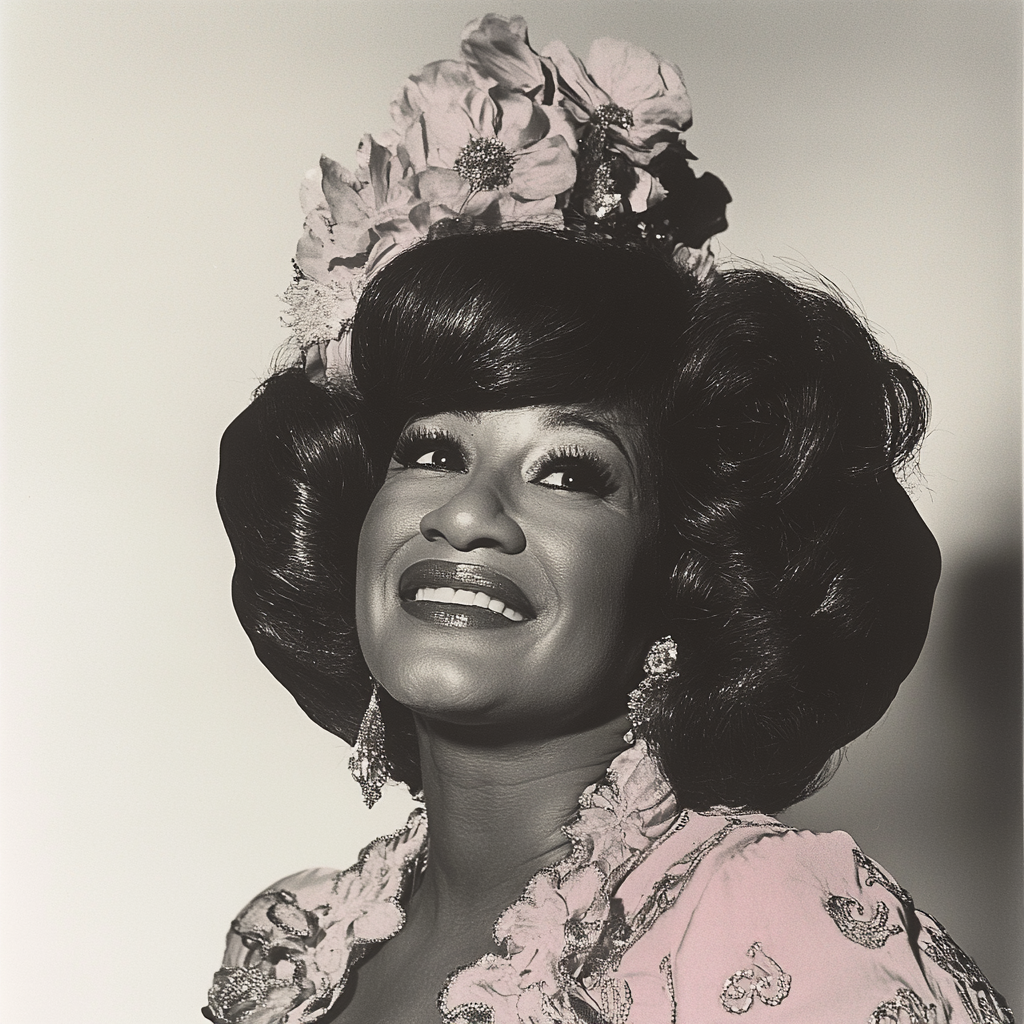
During her teenage years, she took part in local radio competitions and performed in cabarets, supported by her family and community. These formative experiences fostered her rich rhythmic sense and charismatic stage presence that would later define her sound.
Cruz's immersion in Afro-Cuban cultural and spiritual practices, such as learning Santería songs from neighbors, lent emotional depth and authenticity to her singing and laid the foundation for her later career.
In the late 1940s, she joined touring groups and attracted wider attention, culminating in her historic role as lead singer of La Sonora Matancera in 1950, a breakthrough that marked the first black woman to lead the ensemble.
Celia's well-known catchphrase „¡Azúcar!“ („sugar“ in German) became synonymous with her persona. This word embodied her energetic performances, her creative spirit and her zest for life. It became a rallying cry of joy, love and cultural pride, an apt representation of her indomitable spirit.
Celia Cruz's life and career were strongly influenced by the political upheavals of the Cuban revolution and the subsequent communist regime. After Fidel Castro came to power in 1959, Havana's cultural landscape, once a thriving place for nightlife and artistic expression, was heavily regulated and censored. When media and entertainment venues were nationalized and obliged to follow the party line, many artists found their freedom restricted.
In June 1960, Cruz and her orchestra La Sonora Matancera, then on tour in Mexico, decided not to return to Cuba, a decision that would ultimately shape their future.
The Cuban government permanently refused her return and even banned her from attending her parents' funerals years later; the only opportunity she had to perform on Cuban soil after her exile was at the US naval base in Guantánamo Bay, separated from the island by fences and politics.
This forced separation reinforced her identity as a diaspora artist and a symbol of resistance against authoritarian cultural restrictions.
In exile, she navigated the emotional and professional challenges of living in the US while maintaining her roots.
Their catchphrase „¡Azúcar!“, which developed from a spontaneous exclamation into a symbol of joy and cultural pride, also became an expression of their identity in the face of uprooting and political censorship.
This combination of art and resistance, even if not always explicitly political in the texts, embodied a deep commitment to creative freedom and cultural survival.
Born in Cuba, Celia Cruz spent much of her early life immersed in the rich cultural fabric of her homeland. However, after the Cuban Revolution in 1959 and the rise of Fidel Castro, Havana's nightlife and forms of expression were severely restricted. Seeking freedom for self-expression, Celia fled Cuba and began a journey that would make her a global icon.
Her exile came at a personal cost; she was prevented by the Cuban government from returning to her homeland, a heartbreaking consequence of her resistance.
Celia Cruz's rise to international fame was not immediate, but developed over decades of tireless dedication and artistic renewal. After her appointment as lead singer of La Sonora Matancera in 1950, Cruz gained widespread recognition in Cuba and Latin America for her powerful, emotional voice and dynamic stage presence. Her departure from Cuba in the early years of the revolution marked the beginning of a global journey.
Settling in the US in the early 1960s, she married trumpeter and longtime collaborator Pedro Knight, who became her manager and creative partner. Cruz navigated a music industry that did not always welcome Afro-Latina female artists, but she soon forged influential alliances with notable figures such as Tito Puente and recorded several albums with him in the 1960s.
Her collaboration with Fania Records in the 1970s marked a crucial turning point: the growing salsa label introduced her to a wider audience, particularly in New York's burgeoning Latin music scene. With Johnny Pacheco, she created the seminal album Celia & Johnny (1974), which included the iconic track „Quimbara“, a defining anthem of the genre that cemented her role as salsa queen.
Cruz's sumptuous costumes, extravagant wigs and energetic performances made her stand out in a competitive market and helped bridge cultural and linguistic boundaries, attracting diverse audiences in America and Europe.
Over the course of her career, she recorded over 80 albums, won several Grammy Awards and collaborated with artists worldwide, making her one of the most enduring voices in popular music of the 20th century.
In Germany, where movements are increasingly demanding recognition of the country's colonial history, Celia's music had a particular resonance. The Afro-German community, instrumental in raising awareness of colonialism, racism and discrimination, drew inspiration from Celia's work. Her rhythms of resistance spoke to their struggles for equality and recognition of historical injustices.
Although Celia Cruz's direct influence on Germany's decolonial movements has not yet been extensively studied academically, her music, deeply rooted in Afro-Cuban rhythms and expression of identity, with struggles for racial recognition and cultural self-determination in European contexts.
In Germany, colonial history and racial issues have shaped the formation of Afro-German identity over the last century. Afro-Germans trace their presence back to colonial encounters and migration patterns; today, there are organized movements that address systemic racism, cultural representation and historical reappraisal.
Organizations such as Generation ADEFRA are committed to the visibility and empowerment of Black women in German society and are working to address the traces of exclusion and racist prejudices rooted in colonial and post-colonial histories.
Cruz's embodiment of Afro-Latino pride and its global visibility serve as a cultural reference point for diasporic communities seeking affirmation of Afro-identity narratives beyond national borders.
Their rhythms of resistance and celebration transcend geographical borders and offer a common language of cultural expression and resistance against historical marginalization, which Afro-German activists also face.
Germany's broader movement to recognize its colonial past intersects with global diasporic narratives about reclaiming black history and identity. In this context, Cruz's work reinforces themes of cultural resilience, historical memory and the enduring power of artistic expression to challenge dominant cultural narratives.
Celia Cruz's music reminds us of the transformative power of culture, identity and collective action. Her vibrant songs embodied defiant joy and unwavering hope, serving as a call to those seeking justice and liberation. By reclaiming Afro-Cuban rhythms and celebrating their heritage, she created a space of resistance to oppression and an affirmation of cultural identity.
One of the most striking elements of Celia Cruz's persona was her electrifying catchphrase ’¡Azúcar!„, which went beyond its literal meaning to become a symbol of joy, resilience and cultural pride.

Beyond its playful origins, „¡Azúcar!“ became synonymous with their rejection of restrictions, political, artistic or aesthetic, and their celebration of Afro-Cuban identity in a globalized musical world.
Her stage presence further reinforced this message: gorgeous, multi-colored wigs, glittering dresses, elaborate accessories and her signature rumba dress transformed every performance into a colorful spectacle celebrating Afro-Caribbean heritage and female empowerment.
The combination of sound and style reflected a broader cultural reconquest to show pride in Afro-diasporic rhythms at a time when the mainstream entertainment market often marginalized non-white artists.
Combining traditional Afro-Cuban music with contemporary arrangements, Cruz showcased the richness of her roots while inviting global audiences to experience the joy in her rhythms.
Celia's life and music provide a powerful lens through which to explore and experience decoloniality, not only in Germany but worldwide. Her journey from exile to global icon underscores the enduring power of cultural expression as a tool for liberation and solidarity.
Celia Cruz's career also offers a powerful look at the intersections of gender and race in music.
As a black woman in a genre historically dominated by male artists and producers, Cruz defied expectations and became one of the most visible female figures in Latin American music.
Her presence on stage was not only musical, but also political: by taking up space confidently and expressively, she challenged norms about who could be a leading voice in popular music.
Her flamboyant costumes, radiant energy and unwavering stage presence confronted stereotypes that often marginalized Afro-Latina women in the industry and in broader cultural narratives.
Cruz's artistic journey illustrates how music can be a site of resistance against gendered and racialized restrictions, empowering future generations to redefine cultural norms and secure spaces in artistic landscapes.
Celia Cruz's life and music embody the idea that cultural expression can be a profound tool for social change. Music has always served communities as a means of preserving memory, expressing identity and creating solidarity, especially for peoples whose history has been oppressed or marginalized.
Cruz's celebration of Afro-Cuban rhythms, her commitment to joy in the face of exile and her global reach show how music transcends borders and becomes an instrument of empowerment.
Their songs, though not always explicitly political, carried an implicit affirmation of black identity and diasporic culture that appealed to listeners confronted with racism, displacement or cultural erasure.
Music thus becomes a space where personal narratives meet broader struggles for justice, dignity and inclusion. Cruz's legacy invites us to reflect on how artistic expression can challenge dominant cultural paradigms and foster community resilience.
Across continents and decades, their rhythms of resistance animate movements that aim to decolonize cultural memory and reclaim spaces for historically marginalized voices.
By reclaiming and celebrating Afro-Latin musical heritage, Cruz not only entertained audiences, but offered tools for reflection, connection and collective transformation, a reminder that when art is at its best, it can be both beautiful and revolutionary.
Which song by Celia Cruz inspires you the most? Share your favorite tune in the comments and let's celebrate their message of freedom together!
https://www.britannica.com/biography/Celia-Cruz
https://celiacruz.com/biography/
https://www.womenshistory.org/education-resources/biographies/celia-cruz
https://www.womenshistory.org/education-resources/biographies/celia-cruz
https://womenshistory.si.edu/blog/why-celia-cruz-called-queen-salsa
https://en.wikipedia.org/wiki/Afro-Germans
https://www.researchgate.net/publication/401663820_Oxford_Bibliographies-Celia_Cruz-Hudde