
Why can't heroes be female? Have you ever asked yourself that? Perhaps this narrative is wrong. Throughout history, countless women have emerged as leaders, warriors and strategists, challenging conventional expectations. One such figure is Anacaona, a legendary queen who fought against the Spanish colonists in the Caribbean in the 16th century.
Before European ships appeared on the horizon in 1492, the island of Hispaniola was home to a thriving Taíno civilization with a highly organized social, political and spiritual structure. The Taíno had developed sustainable agricultural systems based on manioc (yuca), corn, beans, squash and peppers, grown in raised fields called conucos to maintain soil fertility and increase crop yields. Their villages, called yucayeques, were carefully organized around central plazas that served as sites for ceremonies, ball games and communal gatherings. Skilled canoe builders and navigators maintained trade networks across the Caribbean, linking Hispaniola with Cuba, Puerto Rico and the Bahamas. Spiritually, their worldview revolved around Zemís, ancestors, and nature spirits, which were embodied in carved objects and sacred places. Ritual leaders, known as bohíques, performed ceremonies, often with cohoba rituals, to communicate with the spiritual world. Social hierarchies existed, but society was structured cooperatively, led by caciques, supported by nobles, the nitaínos, and guided by spiritual leaders. Far from being a disorganized or „primitive“ society, the Taíno had complex systems of government, agriculture, art and faith long before European colonization destroyed their world.
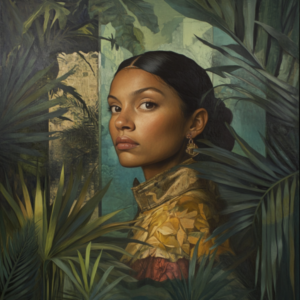
These women not only relied on physical strength, but used charm, knowledge and feminine power to fight for the right of their people to live in their homeland. Anacaona, whose name means „golden flower“ in the Taíno language, was a remarkable leader in what is now Haiti, particularly in the Jaragua region. Her story is one of resilience, wisdom and courage, making her an unforgettable figure in Caribbean history.
At the time of European arrival, Hispaniola was divided into five large taíno-cacicazgos: Marién, Maguá, Maguana, Higüey and Jaragua. Each territory functioned as a political unit governed by a hereditary cacique whose authority extended over subordinate leaders and communities. These leaders organized agricultural production, distributed food and resources, oversaw spiritual ceremonies, and maintained diplomatic relations with neighboring cacicazgos. Jaragua, the region later ruled by Anacaona, was one of the largest and most culturally influential regions on the island. Political legitimacy was supported by ceremonial gatherings and symbolic objects such as carved wooden seats, called duho, which signaled authority and sacred status. Boundaries between cacicazgos were often marked by natural landmarks such as rivers and mountains, signifying territorial awareness and political organization. This structured system shows that Hispaniola had established governmental structures and regional sovereignty prior to the Spanish conquest, refuting colonial narratives that portrayed the island as politically undeveloped.
Born into a high-ranking family, Anacaona was married to Caonabo, a powerful cacique of the Maguana region.
Taíno society followed matrilineal patterns of succession, meaning that descent and succession were often traced through the maternal line. This structure allowed women to inherit authority and property and opened up avenues for female leadership within the political hierarchy. Women cultivated essential crops, organized food production and played central roles in maintaining household and community stability. They also participated in ceremonies and diplomatic events, especially through marriage alliances that strengthened political bonds between cacicazgos. If a male cacique died without a direct male heir, leadership could pass to his sister or daughter, an expression of the flexibility of Taíno governance. Anacaona's later succession as Cacica of Jaragua was thus in line with cultural norms. Compared to contemporary European societies, where political power was predominantly male-dominated, the Taíno organization offered women greater visibility and influence in public life. This cultural understanding is crucial to recognizing Anacaona not only as an exceptional woman, but as a legitimate and recognized leader of her own society.
She was present at the arrival of Christopher Columbus in 1492, an event that marked the beginning of immeasurable suffering for the Taíno.
The arrival of the Spanish marked a dramatic turning point in Caribbean history. Initial encounters between Taíno and Europeans were characterized by curiosity and cautious exchange, but these interactions soon turned into exploitation. Spanish settlers sought gold and labor and introduced tribute obligations that forced Taíno communities to deliver resources under threat of punishment. The encomienda system institutionalized forced indigenous labour, whereby Taíno workers were assigned to Spanish colonists for mining and agriculture under harsh conditions. Violence, overwork, displacement and the spread of diseases such as smallpox and measles led to a drastic population decline. Within a few decades, the social and political fabric of Hispaniola was completely transformed. Entire communities were destroyed and traditional leadership structures weakened under colonial pressure. Against this backdrop, leaders such as Caonabo and later Anacaona fought for the autonomy and survival of their people.
Caonabo, Cacique of Maguana and Anacaona's husband, was one of the first organized resistance leaders against Spanish colonization. Known for his strength and defiance, he opposed the establishment of Spanish settlements and is often associated with the destruction of La Navidad. Recognized as a threat, he was captured by stealth and allegedly imprisoned with handcuffs disguised as ceremonial objects. His death weakened the centralized military resistance, but did not extinguish the will of the indigenous people to resist foreign rule. This marked a shift in strategy from direct confrontation to diplomatic and adaptive forms that Anacaona's leadership in Jaragua was preparing.
By this time, the Spanish had already begun to enslave and massacre the Taíno in order to assert control over the island. Despite these challenges, Anacaona remained a beacon of leadership, determined to protect their people from complete annihilation.
Resistance to Spanish expansion was not limited to isolated incidents, but involved coalitions across several cacicazgos. Taíno troops mobilized to repel Spanish forces, demonstrating cooperation and common political interests between regions such as Maguana, Jaragua and Higüey. Nevertheless, Spain's advantages in steel weapons, cavalry and military tactics proved devastating. Battles such as Vega Real illustrated the power imbalance as the indigenous fighters faced unfamiliar forms of warfare. Despite these setbacks, resistance continued through migration to mountainous regions, refusal to pay tribute and the preservation of cultural practices under colonial rule. Resistance was therefore not only military, but also cultural and spiritual, an expression of resilience rather than subjugation.
As Cacica of Jaragua, Anacaona ruled during one of the most unstable periods in Caribbean history. Her leadership combined diplomacy, ceremonial authority and cultural preservation. She organized gatherings that strengthened alliances and maintained political stability, often incorporating areítos, traditional performances of song, dance and poetry that reinforced community identity. Through negotiation and hospitality, they sought to protect their cacicazgo from direct confrontation while still maintaining autonomy. Her role was not limited to government; she was also a poet and cultural figure who embodied the intellectual and artistic traditions of her people. Her leadership demonstrates a multi-layered resistance that combined diplomacy with quiet defiance in the face of colonial aggression.

Their leadership and resistance made them a symbol of Taíno resilience, but ultimately led to their downfall. In 1503, the Spanish governor Nicolás de Ovando falsely accused them of conspiring against the Spanish. Under the pretext of peace talks, Anacaona and her people were invited to negotiate, only to be attacked and captured by the Spanish. During the massacre of Jaragua, Spanish troops attacked unarmed Taíno leaders who had gathered for a ceremony. Many were killed, others imprisoned, and the political leadership of the region systematically destroyed. This calculated betrayal eliminated organized indigenous authority in Jaragua and consolidated Spanish dominance. Despite her unwavering courage, Anacaona was hanged, a tragic end to a life dedicated to the survival of her people. But even in death, her legacy remained alive.
Anacaona's name continues to be honored throughout the Caribbean, especially in Haiti, where she is celebrated as a national heroine. Her story is immortalized in literature, music and art, especially in the town of Léogâne, which cherishes her memory. Her life and her struggle are a reminder that true leadership takes many forms. Her story challenges the notion that warriors must always be men and shows that strength, intelligence and resilience make a true hero, regardless of gender.
Have you ever heard of Anacaona? Her story is one of courage and resistance and has inspired countless generations. There is so much more to learn about this incredible queen and her fight against colonial oppression. What do you think about Anacaona's legacy? Share your thoughts in the comments below!
Sources:
https://www.britannica.com/place/West-Indies-island-group-Atlantic-Ocean/The-Pre-Columbian-period
https://www.britannica.com/biography/Nicolas-de-Ovando
https://www.britannica.com/place/Leogane#ref1074945
https://www.britannica.com/topic/encomienda
https://nativeboundunbound.org/history/chronology/
https://www.smithsonianmag.com/travel/what-became-of-the-taino-73824867/