
Homosexuality on the African continent has become a taboo subject in many modern contexts, with several African leaders, such as Uganda’s Yoweri Museveni, claiming that LGBTQIA+ identities are a Western import and contradict „African culture.“ However, these views fail to take into account the continent’s deeper history. Homophobia in Africa actually has its roots in the colonial legacy and is not an inherent part of African societies.
Pre-colonial Africa was anything but monolithic in its approach to gender, sexuality, and social roles. In various regions—West, East, Central, and Southern Africa—communities exhibited complex conceptions of identity and intimacy that often contradicted rigid Western binary notions. In many traditional societies, gender was linked to social roles rather than exclusively to physical anatomy, and social systems codified flexible ways of relating that included same-sex partnerships, third-gender roles, and socially respected non-heterosexual identities.
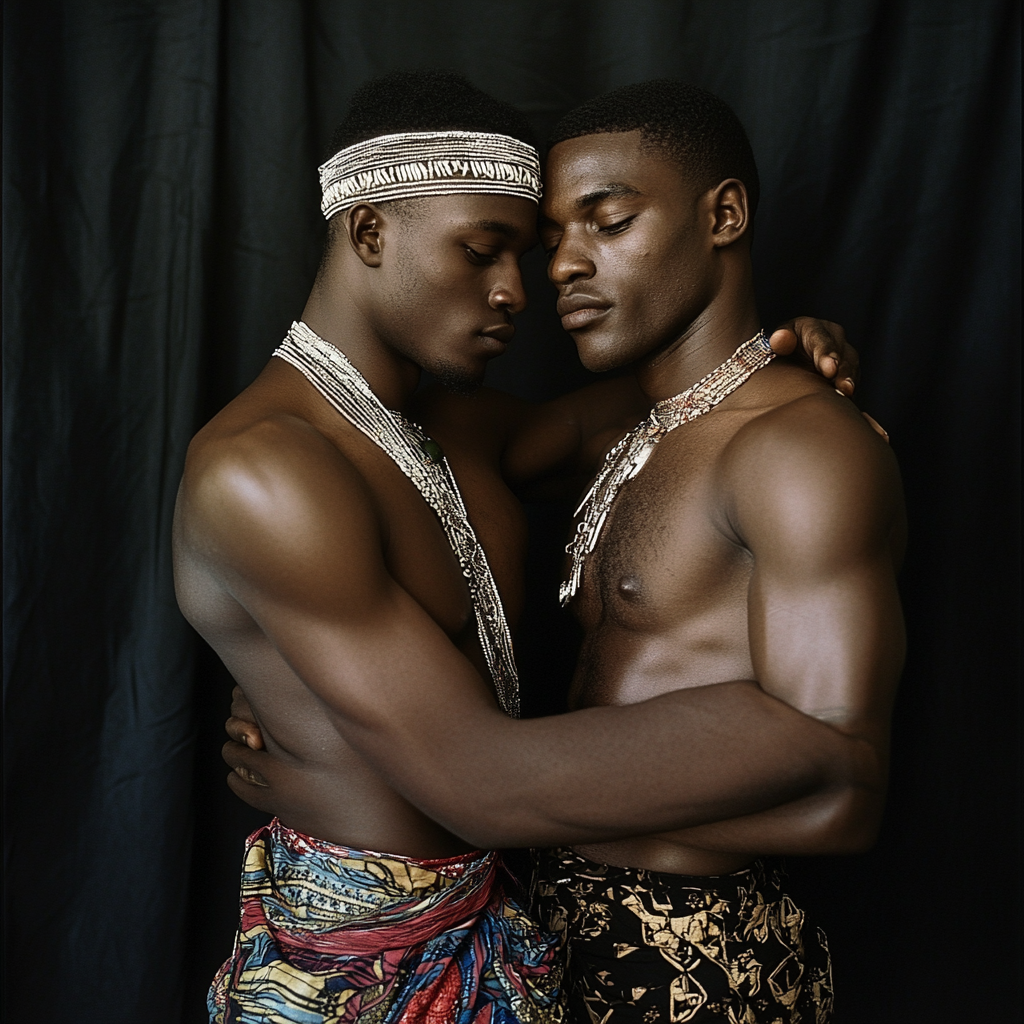
For example, among the Langi in northern Uganda, „mudoko dako“—effeminate men—were historically treated socially as women and could marry men in culturally accepted relationships. Similar nuances are found in „motsoalle“ relationships among Basotho women in present-day Lesotho, where intimate same-sex bonds were celebrated as „special friendships“ and linked to notions of friendship, ritual satisfaction, and communal solidarity—which were not stigmatized later under colonial law.
In parts of Zimbabwe, San rock art depicts erotic same-sex encounters with spiritual significance, suggesting that sexual acts beyond heterosexual norms had ritual significance or social acceptance long before European contact. These cultural practices suggest that African sexuality was deeply interwoven with power structures, spirituality, and community; same-sex acts, for example, could be linked to initiation rites, healing rituals, or cosmological beliefs about the balance of energies in the universe.
The existence of terms in precolonial languages for same-sex relationships and gender diversity further underscores that diverse forms of sexual and gender expression were not foreign to African societies prior to European intervention; rather, they were part of complex indigenous conceptions of the self, community, and cosmology.
Colonial powers imposed rigid gender norms and laws that criminalized homosexuality throughout Africa. These laws, which were based on European Christian doctrines, were alien to the diverse and flexible practices that had existed for centuries before colonization.
A look at pre-colonial African societies clearly shows that homosexuality and non-binary gender identities were not only present but also accepted in various cultural contexts.
Colonialism drastically altered legal and social norms in Africa, particularly with regard to gender and sexuality. When European powers established administrative systems on the continent in the 19th and early 20th centuries, they introduced penal codes based on European Christian moral standards that defined same-sex relationships as criminal „unnatural offenses.“.
Great Britain, Germany, and other colonial powers enacted laws that explicitly criminalized consensual same-sex intimacy and cross-gender expressions. For example, Section 175 of the German Penal Code—the German provision against „unnatural sexual acts“—applied in areas such as Burundi from 1891 until World War I and laid the groundwork for later legal repression; although enforcement was limited, its legacy remained influential in local jurisprudence.
Similarly, British colonial rulers codified anti-sodomy laws in East and West Africa and linked legal penalties to Christian doctrine, which classified non-heteronormative sexuality as sinful. Once introduced, these legal frameworks often outlasted formal colonial rule, as newly independent states retained the colonial legal infrastructure and embedded an imported moral hierarchy into their national systems. Even where indigenous legal practices historically existed, they were superseded by written colonial laws that allowed no recognition of diverse sexual identities.
Historians and anthropologists emphasize that no known precolonial anti-LGBTQ statutes comparable to colonial laws have been found, and that modern criminal codes are primarily a product of colonial legal architecture, not deeply rooted indigenous legal traditions. The legacy of these laws continues to influence legal systems to this day; many African countries still enforce variations of colonial anti-LGBT penalties, including prison sentences, which reflect a legal legacy rather than an organically developed indigenous attitude toward queer identities.
One of the most prominent examples of homosexuality in ancient Africa can be found in Egyptian art. The tomb of Niankhkhnum and Khnumhotep, two men embracing as lovers, stands as a testament to same-sex relationships in ancient Egypt. Furthermore, the concept of a third gender or androgynous expression was recognized and often revered, not only in Egypt but also in other African kingdoms.
While figures such as King Mwanga II of Buganda are well known, many other individuals and social roles illustrate the lived reality of queer identities before and during the early colonial period. In the kingdoms of Ndongo and Matamba (in present-day Angola), a third-gender group known as Chibados important political and spiritual roles. These individuals, who were assigned male at birth, lived socially as women, served as spiritual mediators, married men without formal permission, and were highly respected within local traditions.
Portuguese observers noted that Chibado’s men were able to marry honorably, and some even became part of Queen Nzinga’s court as trusted concubines and advisors. Such figures demonstrate that gender diversity held cultural legitimacy and served a social function, rather than being marginalized or stigmatized. Furthermore, among the Igbo in southeastern Nigeria, the institution of female husbands allowed women with economic means to assume male social roles and marry women, often to continue family lines, form kinship alliances, or secure socioeconomic status.
This practice did not reflect Western models of gender identity, but was an indigenous social category that expanded the possibilities of interpersonal relationships beyond simple male/female binary systems. These historical realities show that precolonial African societies had fluid systems of gender and sexuality that were not forced into the binary categories later introduced by colonial administrations and Christian missionaries.
The erasure of such stories from conventional historical narratives is attributable more to colonial reinterpretation and postcolonial cultural policy than to a historical absence of queer lives. Recognizing and centering figures such as the Chibados and female husbands allows modern readers to recognize that diverse expressions of intimacy, identity, and gender roles were not exceptions but rather part of local social structures.
In the 16th century, the Imbangala accepted men who wore women's clothing and lived among their wives, reflecting a flexible view of gender roles and relationships.
The Igbo and Yoruba did not operate on the basis of a rigid gender binary. Gender was not assigned at birth but was determined later in life based on social roles and personal characteristics.
The Dagaaba assigned gender based on a person's energy, not on anatomy, which demonstrates a deep understanding of gender as a spectrum.
In many traditional African societies, forms of sexual and gender expression that today might be described as LGBTQ+ were often contextualized within broader cultural, spiritual, or communal practices. Relationships that modern Western categories would classify as same-sex relationships were sometimes integrated into rituals, rites of passage, and social ceremonies with spiritual significance.
For example, among several Bantu groups in South Africa, emotional and erotic relationships between adolescent girls—sometimes referred to as „mommy-baby“ friendships—played a role in socialization, mutual support, and preparatory engagement, which was viewed as complementary to later marital obligations. In other regions, certain forms of same-sex intimacy were linked to conceptions of the cycle of life energy, power, or spiritual efficacy.
In some West African kingdoms, sexual acts between older and younger individuals were embedded in cosmological concepts of renewal and strength; they were not merely random but held cultural significance that linked individual bodies to the common good. Among the Nupe in Nigeria and the Azande in Sudan and the Congo, same-sex relationships could be associated with rituals that enhanced personal power or affirmed the community’s protection.
Gender diversity was also evident in spiritual roles: Certain female spiritual healers or mediators embodied gender fluidity as part of their role in order to enter both male and female realms of the sacred. These diverse practices demonstrate that African traditions did not view sexuality and gender through the narrow lens of binary identities imposed by later Western frameworks. Rather, many communities conceived of intimate relationships and gender roles as dynamic and context-dependent, often interwoven with ritual life, spiritual cosmology, and social cohesion.
By expanding our understanding beyond colonial categories, it becomes clear that precolonial African societies had complex systems of meaning that recognized diverse forms of gender and sexual expression as meaningful social phenomena.
One of the most compelling stories comes from Buganda (modern-day Uganda) and its last monarch before colonization, King Mwanga II. In the late 1880s, King Mwanga was an openly gay ruler who resisted the growing influence of Christian missionaries and European colonizers.
When missionaries attempted to convert his people, Mwanga ordered their execution in order to preserve the way of life of his kingdom. This historical narrative has been distorted over time; colonial interpretations portrayed Mwanga’s sexuality as a moral failure. However, his resistance to colonization and Christian influences in Buganda underscores the existence and acceptance of homosexuality prior to Western influence.
Documented evidence of non-heteronormative gender and sexual expressions in Africa extends beyond written history into anthropology, archaeology, and ethnography. For example, cave art and rock engravings in Zimbabwe depict same-sex activities, which scholars interpret as part of spiritual or communal practices, suggesting that such forms of expression were neither hidden nor exceptional, but rather integrated into cultural cosmologies.
Linguistic analyses also support the indigenous recognition of diverse relationships; many African languages had specific terms for people outside binary gender roles or in same-sex relationships long before contact with Europeans.
This evidence is consistent with anthropological studies showing that gender identity in many traditional societies was based on role, behavior, or spiritual status, rather than on strict biological criteria. Among the Wolof in Senegal, there were historical terms for men who were recognized by society as gender-atypical, and among the Basotho, nuanced vocabulary captured relationships that Western categorizations might overlook.
Archaeological finds and ethnographic records sometimes reveal the physical presence of gender-nonconforming individuals whose burial rites included gender-specific indicators that did not fit into simple male/female frameworks, suggesting a ritual recognition of gender fluidity.
Some rock and cave sites are interpreted as social spaces where erotic or ritual activities involving same-sex symbolism took place, suggesting cultural legitimacy rather than marginal secrecy. These layers of evidence illustrate the continuity of diverse gender and sexual experiences throughout African history and refute the notion that such identities were imported in the modern era.

The examples mentioned above show that queerness was not uncommon in pre-colonial Africa. Gender and sexuality were viewed through diverse and culturally specific lenses, far removed from the binary norms introduced by European colonizers.
The intersection of religion and sexuality in Africa illustrates the profound shifts in social norms that occurred following colonization and missionary work. Pre-colonial Africa was home to a broad spectrum of spiritual traditions that often viewed sexuality and gender diversity as integral elements of cosmology and community life, rather than as deviations to be suppressed. Many indigenous spiritual systems included narratives, ceremonies, and roles that recognized gender variations and same-sex intimacy as spiritually significant.
However, the spread of Christianity—and, in some regions, Islam—under colonial and postcolonial dynamics led to doctrinal frameworks that typically classified non-heteronormative sexuality as morally sinful or socially dangerous. Christian missionaries played a decisive role in reshaping indigenous conceptions of family, the body, and community by linking homosexuality to moral deviance and introducing penal codes that later informed colonial legislation.
Scholars note that anti-LGBTQ legal frameworks and cultural stigmatization did not exist prior to colonial influence, and that no known indigenous penal system included the severe sanctions introduced by colonial states; Rather, homophobia in the law is a legacy of colonial imposition. Consequently, modern legal and social hostilities in many African countries today often invoke religious interpretations—whether Christian or Islamic—as justification, even though the actual historical tradition encompassed far more flexible and diverse forms of sexual and gender expression.
Understanding this historical shift reveals how African spiritual landscapes were profoundly transformed by the alliance between colonialism and religious institutions, embedding normative frameworks that marginalized gender and sexual diversity over time—an outcome that modern movements seek to rectify through the reappropriation and revitalization of precolonial spiritual conceptions of identity and relationships.
Anyone who would like to learn more about this fascinating story can read books such as Boy-Wives and Female Husbands and kenyan, christian, queer Read.
In addition, we offer Tours or cultural experiences that deepen this rich history, offering further insights into Africa’s precolonial past. Homophobia may be vocal in Africa today, but history tells a different story: one of fluidity, acceptance, and resistance to colonial impositions. It is time to reclaim these narratives and understand the true diversity of African identities.