
Last January, South Africa filed a major case against Israel with the International Court of Justice, accusing the country of genocide against the Palestinian people.
This case sparked an intense online debate about whether true justice can even be achieved through such formal legal channels. Many believe that these systems are designed to protect the powerful and perpetuate the same interests time and again.
If you've ever wondered whether true justice can be achieved through existing institutions, there's a film that addresses these very questions in a unique way: *Bamako*, directed by Abderrahmane Sissako.
The Film Bamako was directed by Abderrahmane Sissako, a Mauritanian filmmaker known for his deeply reflective and politically engaged films. His work often addresses themes such as migration, identity, globalization, and the long-term effects of colonialism in Africa.
Sissako’s cinematic style is unique because he combines poetic imagery with realistic social criticism, creating films that feel both intimate and globally relevant. This approach is particularly evident in *Bamako*, as he constructs a fictional court trial that simultaneously feels disturbingly real.
The film is part of a larger body of work that also includes *Timbuktu*, which likewise explores power structures and human resilience under oppressive systems.
Sissako’s background—having lived in several countries, including Mali, France, and the Soviet Union—strongly shapes his perspective and enables him to portray global issues in a nuanced and personal way. His films often defy simple narrative patterns and instead encourage viewers to think critically about power structures and inequality.
*Bamako* reflects his belief that cinema can be a space for political dialogue, especially for voices that are often excluded from the mainstream. The decision to depict a trial against international financial institutions is not only artistic but also deeply political, as it offers ordinary African citizens a platform to voice their concerns, which are rarely heard in global forums. Through this film, Sissako positions himself not only as a storyteller but also as a facilitator of global discussions on justice and accountability.
"Bamako" is set in Mali's capital and depicts a fictional trial taking place in a backyard, where ordinary citizens and lawyers bring international financial giants such as the World Bank and the International Monetary Fund to justice. They accuse these institutions of exploiting African countries and exacerbating poverty through the debt system.
What makes *Bamako* special is that the film doesn't unfold like a traditional courtroom drama. Instead, it interweaves everyday life with serious courtroom scenes, allowing viewers to feel the tension between official legal systems and the reality of everyday life.
The criticism presented in *Bamako* is deeply rooted in the historical reality of debt and economic dependence faced by many African countries. After gaining independence in the mid-twentieth century, numerous African states faced significant economic challenges and turned to institutions such as the World Bank and the International Monetary Fund for financial assistance.
These loans were often tied to strict conditions—known as structural adjustment programs—that required governments to reduce public spending, privatize state-owned enterprises, and open their markets to global competition. Although these measures were intended to promote economic growth, they often led to limited access to basic services such as health care and education, as well as to growing social inequality.

Many countries found themselves caught in cycles of debt, in which they had to take out new loans to pay off existing debts. This dynamic created a form of economic dependence that is often described as neocolonialism. “Bamako” addresses this issue by putting these institutions on trial and giving citizens the opportunity to describe their personal experiences with economic hardship.
The film's narrative aligns with real-world critiques by economists and activists who argue that global financial systems often prioritize the interests of wealthy nations over those of developing countries. By embedding the fictional trial in this historical context, *Bamako* becomes a powerful commentary on global economic injustice.
What makes *Bamako* so unique is the way the film blends the surreal with the natural. The courtroom is set up in a small, informal backyard, and the solemnity of the trial is constantly interrupted by the life going on around it: weddings, children playing, and conversations among neighbors. This interplay conveys a clear message: justice is not an isolated or abstract concept, but is deeply rooted in everyday life.
One of the most powerful aspects of *Bamako* is its use of space as a symbolic element. The entire process takes place in a courtyard—a place that is both ordinary and significant. In contrast to formal courtrooms, which are often associated with authority and exclusivity, the courtyard is a communal space where everyday life unfolds. This choice challenges traditional notions of where justice is administered and who has the right to participate in it.
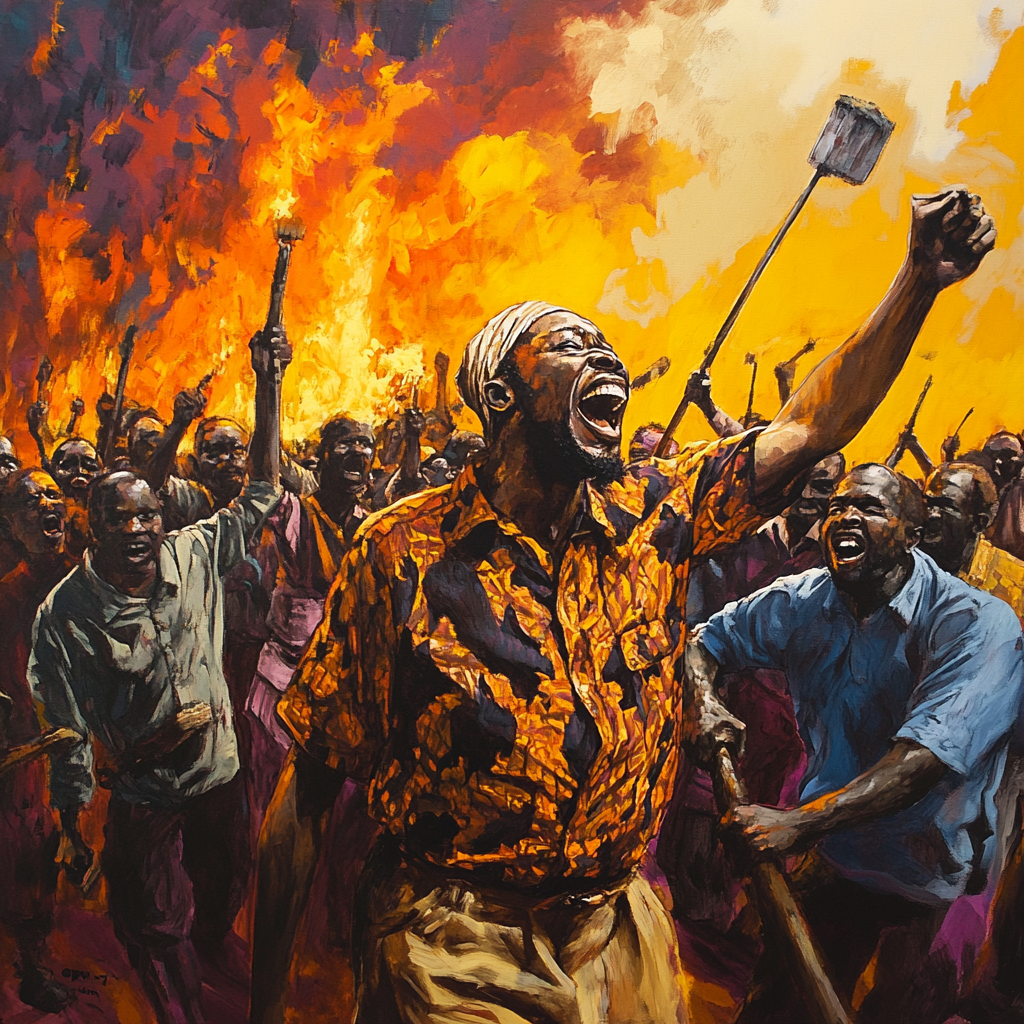
The presence of everyday activities—such as conversations, music, and movement—in the same space as the trial creates a dynamic contrast that highlights the close connection between life and the law. The courtyard becomes a microcosm of society and represents both the limits and the possibilities of justice. It suggests that legal proceedings cannot be separated from the social contexts in which they take place. This spatial symbolism also reflects broader themes such as accessibility and participation, as the proceedings are open to the community and not reserved solely for an elite.
The blurring of the lines between private and public spaces reinforces the idea that issues of justice are not limited to institutions but are part of everyday experiences. By using a familiar and tangible setting, the film makes complex political ideas more accessible and encourages viewers to rethink existing notions of justice.
The editing shifts between these scenes in a way that encourages viewers to reflect on the meaning of justice, the mechanisms of power, and the influence of the media and financial systems. This results in a powerful visual and intellectual statement.
"Bamako" stands out not only for its political message but also for its innovative cinematic style. The film combines documentary elements with fiction, creating a hybrid form of storytelling that challenges traditional structures. One of the most striking techniques is the juxtaposition of everyday scenes with formal court proceedings. Scenes of children playing, conversations, and daily routines are set side by side with intense legal debates.
This narrative style creates a connection between personal experiences and global issues and shows that political decisions have concrete effects on daily life. The use of non-professional actors alongside trained actors enhances the authenticity and makes the courtroom scenes feel like real witness testimonies.
The cinematography is understated and observational, making the scenes feel natural and giving the audience the sense that they are witnessing real events. The sound design also contributes to this effect by blending ambient sounds with dialogue, thereby reinforcing the connection between the courtroom and its surroundings. This approach breaks with the conventions of classic courtroom films, which often depict legal proceedings in isolation, and instead integrates them into a vibrant social setting.
One of the strongest aspects of *Bamako* is that the film does not limit its criticism to international institutions. It also sheds light on the role of African governments in perpetuating inequality and shows that responsibility is complex and multifaceted. This perspective makes it clear that both global and local actors can contribute to the persistence of economic problems.
Bamako can be understood particularly well through the lens of postcolonial theory, which examines the enduring effects of the Colonialism . Thinkers such as Frantz Fanon and Achille Mbembe argue that colonial power structures did not disappear after independence but have persisted in new forms. These include economic dependencies, cultural influence, and political pressure exerted by global institutions and former colonial powers.
In *Bamako*, these ideas are reflected by showing how such power structures continue to shape people’s lives. The concept of neocolonialism is particularly relevant here, as it describes how states are formally independent but remain economically constrained. The film also addresses structural violence—that is, systems that prevent people from meeting their basic needs. By giving ordinary people a voice, *Bamako* challenges dominant narratives and offers an alternative perspective on global inequality.
The cast, including Danny Glover, William Bourdon, and Aïssata Tall Sall, bring a special intensity to their roles. The emotional and political depth of the themes becomes particularly evident in the long monologues, revealing how justice is often staged rather than actually accessible.
The film also raises fundamental questions about the ability of legal systems to deliver true justice. Institutions such as the International Court of Justice are designed to resolve conflicts between states and enforce international law, yet their effectiveness is often called into question. Critics argue that such institutions are influenced by political power dynamics and have limited enforcement mechanisms, allowing powerful states to evade accountability.
This issue has also been highlighted by recent developments such as the case of South Africa v. Israel (Genocide Convention case), which has sparked global discussions about the role of international law. In Bamako, the mock trial serves as an alternative vision of justice outside formal institutions. Here, ordinary citizens take on the role of prosecutors and challenge existing hierarchies. This suggests that true justice may require new, more inclusive forms.
If you're interested in how fiction can portray complex social and political conflicts, *Bamako* is a film well worth watching. It uses narrative techniques to encourage critical reflection on power structures and raises the question of who actually benefits from existing systems. Rather than providing simple answers, the film opens up space for discussion and leaves a lasting impression.