
In today’s world, where history often seems like a distant tale from the past, there are figures like Anton Wilhelm Amo whose stories must be heard and remembered. Amo’s life bears witness to the richness and complexity of human experience and illustrates how the narratives of African people have been systematically erased or ignored in dominant historical accounts.
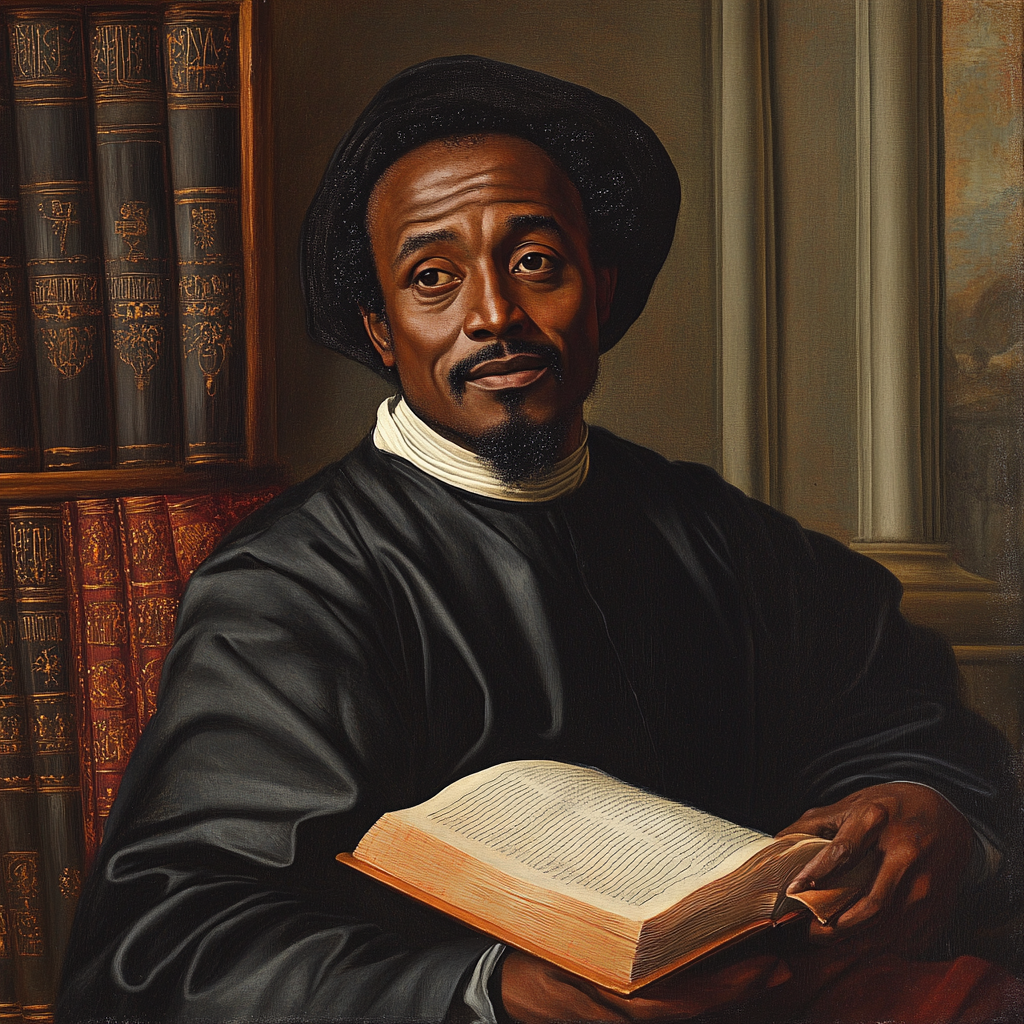
Anton Wilhelm Amo's life unfolded during the intellectual era known as the Enlightenment, a time when European thinkers emphasized reason, science, and the pursuit of knowledge. Throughout the 18th century, philosophers and scholars sought to challenge religious authority and traditional power structures by advocating for rational inquiry and empirical observation. This era produced influential thinkers whose works shaped debates on morality, human nature, and the organization of society. Universities across Europe became centers of intellectual development where philosophical ideas were discussed and scrutinized.
Yet the Enlightenment was also marked by profound contradictions. While philosophers championed ideals of universal reason and human equality, many simultaneously supported colonial expansion and racist hierarchies that justified the exploitation of non-European populations. European powers expanded their influence through colonialism and trade networks that connected Europe with Africa, Asia, and the Americas. Intellectual discourse often ignored the experiences and contributions of people from these regions, even though European prosperity was closely intertwined with colonial systems.
In this context, the presence of an African philosopher in the European academic world was both remarkable and disruptive. Amos’s participation in scholarly debates challenged the prevailing assumption that intellectual achievements were the exclusive preserve of Europeans. His education and subsequent academic career demonstrate that the Enlightenment was not merely a European story, but part of a broader global exchange of ideas. Understanding this historical context highlights just how extraordinary Amos’s achievements truly were and how his life challenges simplistic narratives about Enlightenment philosophy and European intellectual history.
Born in what is now Ghana in the 18th century, Amos’s life story is remarkable. At a time when slavery and colonialism were widespread, he became one of the first Africans to attend a European university. His path into the academic world, however, stemmed from a tragedy. As a child, he was captured and taken to Europe, where he was given as a gift to Duke Anton Ulrich of Brunswick-Wolfenbüttel. Despite the grim circumstances of his arrival, the duke recognized Amos’s intelligence and provided him with an education. He was eventually sent to the University of Halle in Germany—an extraordinary opportunity for an African man in an era when education was mostly a privilege reserved for noble European men.
It is impossible to understand the early life of Anton Wilhelm Amo without considering the broader historical context of the transatlantic slave trade to take into account. From the 16th to the 19th century, millions of Africans were forcibly transported across the Atlantic and sold into slavery in the Americas. European traders and colonial powers organized extensive trade networks that linked West Africa, Europe, and the New World.
While the majority of enslaved Africans were taken to plantations in the Americas, some ended up in Europe. In certain cases, African children were brought to aristocratic courts, where they served as domestic staff or were presented as symbolic gifts among European elites. These people were often referred to as „court Africans,“ and their presence reflected the complex interplay of power, status, and colonial expansion in early modern Europe.
Amo was one of those children who came to Europe under such circumstances. Although his situation ultimately led to an education and an intellectual career, it began within the violent framework of colonial exploitation. His story illustrates the paradox of the African presence in Europe during this period: while colonial systems dehumanized African people, individual Africans were occasionally able to gain access to elite institutions. The experiences of Africans at European courts and universities show that African history and European history have always been intertwined. Recognizing these connections challenges the misconception that Africans were absent from European intellectual life. Instead, figures such as Amo demonstrate that Africans were present, active, and influential even in societies marked by racial inequality and colonial dominance.
Amos's academic achievements were groundbreaking. He was fluent in several languages and studied fields such as philosophy, mathematics, and law in depth. In 1734, he became the first African to earn a doctorate from a European university, defending a dissertation on the nature of the human mind. His work directly challenged existing European philosophical traditions and expanded the intellectual horizons of his time. Amos’s achievements refute the misconception that Africans have not played a significant role in intellectual history. Knowing his story adds a crucial chapter to our shared past and helps deconstruct the Eurocentric frameworks that dominate historical narratives.
One of his best-known academic works, his dissertation titled *On the Absence of Sensation in the Human Mind*, addressed questions that had been at the center of European philosophy since the time of René Descartes. As is well known, Descartes had postulated a dualistic separation between mind and body and argued that the mind is a thinking substance that exists separately from the physical body. Amo critically engaged with this debate and proposed that sensation occurs in the body and not in the mind itself.
According to Amo, the mind functions primarily as a rational and reflective entity, while sensory experiences arise through physical processes. This argument demonstrates his deep engagement with empirical thinking and scientific methods, which gained increasing importance during the Enlightenment. Amo also authored a work titled *Treatise on the Art of Philosophizing Soberly and Precisely*, in which he emphasized rigorous logical argumentation and careful analysis as central tools of philosophical insight. His writings show that he not only participated in European intellectual traditions but also actively contributed to them.
Despite the Enlightenment ideal of reason and universal knowledge, many philosophers of the 18th and 19th centuries propagated ideas that reinforced racist hierarchies. Some prominent thinkers developed philosophical systems that had a lasting impact on European thought; however, their writings sometimes contained assumptions that placed Europe at the center of human development. These perspectives were shaped by the colonial context, in which European powers dominated global trade and politics.
Philosophical theories about civilization, progress, and culture often positioned Europe as the pinnacle of human development, while Africa and other regions were portrayed as historically or intellectually insignificant. Such ideas contributed to the marginalization of non-European thinkers in academic institutions. Even when African scholars were present at European universities, their work was often overlooked or excluded from the philosophical canon.
Anton Wilhelm Amo’s experiences illustrate how difficult it was for Black intellectuals to gain recognition in a system that often questioned their legitimacy. Although Amo enjoyed academic success during his lifetime, his work largely disappeared from philosophical debates in later centuries. It was not until later that anti-colonial thinkers criticized such racist hierarchies and emphasized that colonial power structures also shaped systems of knowledge. The rediscovery of Amo’s life and work therefore offers an opportunity to question these historical exclusions and to reexamine the foundations of modern philosophical traditions.
Despite his significant contributions, Amos’s legacy has been largely forgotten or erased. Institutions that should be honoring his achievements offer little or no recognition of his history. These omissions are part of a larger pattern of colonial ideologies that persist to this day. The failure to honor figures like Amos highlights the enduring effects of systematic erasure and underscores the urgent need for decolonial practices.
The story of Anton Wilhelm Amo is part of a broader and often overlooked tradition of Black intellectual presence in Europe. Since the 18th century, people of African descent have participated in political, philosophical, and cultural debates on the continent. One of the best known was Olaudah Equiano, whose autobiography described his experiences as an enslaved African and became an important text in the abolitionist movement.
Later thinkers built on this legacy. The scholar and activist W.E.B. Du Bois spent time in Europe and studied at German universities in the late 19th century. His works on race, sociology, and global inequality influenced debates on colonialism and modernity. These examples show that African and Afro-diasporic thinkers have long been part of European intellectual life, even though their contributions have often been marginalized in dominant historical narratives.
Decolonial memory means reclaiming the voices of those who were colonized, enslaved, or marginalized, and reshaping the historical narrative so that their experiences and contributions become visible. It is about challenging dominant narratives and creating spaces for a more inclusive dialogue about the past.
Amos's story shows just how important this form of remembrance is. By recognizing his life and work, we challenge the Eurocentric historical canon that has long excluded African intellectuals.
The spaces we inhabit today—universities, streets, monuments—often still reflect colonial ideologies. The absence of Amos’s history in such spaces reveals how history is curated to privilege certain narratives and erase others. Street Renaming, Monuments or the incorporation of Amos's life into educational programs are concrete ways to honor his legacy.
In recent decades, scholars, activists, and cultural institutions have begun to rediscover the intellectual legacy of Anton Wilhelm Amo. Research in Germany and internationally has examined archival materials to reassess his role in the Enlightenment. Debates have also arisen in Berlin regarding street names and public memory that highlight his historical significance.
These developments reflect a broader movement that critically examines colonial history in public spaces and brings forgotten figures to the forefront.
Decolonial memory means not only uncovering forgotten stories, but also transforming our understanding of history itself. By bringing back voices like Amo’s, we recognize the global interconnectedness of human experiences.
After many years of academic work in Europe, Anton Wilhelm Amo finally returned to the region where he was born, the Gold Coast, now known as Ghana. Historical accounts suggest that he left Europe in the 1740s after experiencing increasing social isolation and discrimination.
He is said to have lived in the city of Axim in Ghana, where he spent his final years. His life story, which connects Africa and Europe, vividly illustrates just how close the intellectual and historical ties between these regions were.
Anton Wilhelm Amos's life reminds us that many forms of knowledge, creativity, and intellectualism were long obscured by oppressive systems. His contributions to philosophy, law, and education deserve recognition, not only for the sake of historical justice, but also to broaden our understanding of our shared human history.
The rediscovery of thinkers such as Anton Wilhelm Amo has sparked an important debate about how academic disciplines—particularly philosophy—can be decolonized. For centuries, university curricula focused almost exclusively on European traditions and overlooked philosophical ideas from Africa, Asia, and the Americas.
Today, many scholars are calling for a broader perspective on global philosophy. These approaches show that European philosophy did not emerge in isolation, but was part of a worldwide exchange of ideas. The recognition of Amos’s work is an important step in this process, as his life demonstrates that African thinkers were actively involved in European philosophical debates centuries ago.
When we reflect on figures like Amo, we are called to action. Decolonial memory is not merely an academic exercise, but a transformative practice that shapes how we understand the past and shape the future. Anton Wilhelm Amos’s story serves as a guide that inspires us to reclaim repressed histories and create a narrative that honors the diversity of human experiences.
If you'd like to learn more about colonialism, visit our Sights Tour in Berlin!
https://plato.stanford.edu/entries/enlightenment/
https://www.britannica.com/event/Enlightenment-European-history
https://www.britannica.com/topic/transatlantic-slave-trade
https://www.metmuseum.org/essays/the-transatlantic-slave-trade
https://plato.stanford.edu/entries/kant/
https://plato.stanford.edu/entries/hegel/
https://www.britannica.com/biography/Frantz-Fanon
https://www.britannica.com/biography/Olaudah-Equiano